Safety is Key When Bicycling in the Door Zone
Winning a door prize—it’s a random, left-to-chance occurrence. And, most likely, it’s a positive happenstance that puts a smile on your face. Not so, however, if you’re riding a bicycle. Cyclists on the receiving end of a door prize—the steel wall of a car’s door that suddenly appears—often find themselves in an emergency room or worse. There is no winning involved.
From the U.S. and Canada to India, Australia, Cyprus and the U.K, the headlines read the same:
- “Cyclist dies after slamming into parked car’s open door”
- “Bicyclist fatally struck after being unseated”
- “Cyclist run over by T bus identified”
- “Deadly war of the road”
“The worst part about the death counts and the injury tolls involving getting doored is that many times such catastrophes could have been avoided,” says attorney Howard Krepack, a partner in the law firm of Gordon, Edelstein, Krepack, Grant, Felton & Goldstein and an avid cyclist. “Educating bicyclists about safely and legally maneuvering on streets with a high volume of cars, including parked cars, is an important first step in reducing accidents. Then it’s a matter of bicyclists getting used to and accepting the fact that when they’re riding a bike they have the same rights and responsibilities under the law as motorists do.”
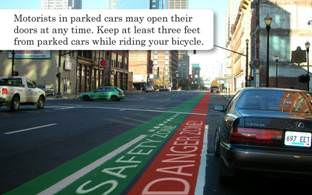 Dispelling some myths may be in order here. First, bike lanes are designed to keep cars out, not to keep bikes in. “You don’t have to keep within the boundaries of those two white lines, particularly if it’s safer to ride to the left of the lane to avoid a car door, pothole or any other kind of obstacle,” says Krepack. Next, “When riding in a bike lane, keep as close to the left line as possible. Many people worry about the cars rushing by on the left, but you’re much more likely to get doored by a parked car than be hit from behind by a motorist who can see you.”
Keeping a three-foot distance from a parked car is a generally accepted rule of thumb to avoid dooring, but keep in mind that some doors are up to 4½ feet long. So, taking the lane may be the best option. On streets where there is no bike lane, it is the only option.
Remember that as a cyclist, you have the same right to that lane as a motorist does. “Taking a lane requires developing a comfort level, but it is definitely the safest thing to do in many instances.”
That comfort level often involves not only the perceived physical dangers involved, but also the emotional obstacles that must be overcome. “It’s easy to get distracted when an angry motorist is motioning to you to move over, or worse, is screaming at you. But bicyclists need to define their space, keep their cool and realize that oftentimes this stems from ignorance about sharing the road.”
Ignorance is not an option for bicyclists. You must be totally aware of your surroundings—from side streets and alleys to pot holes and car doors. Watch for clues that a door may be about to open. Can you see anyone in the car? Do you see brake lights or exhaust? Can you hear the click of the door being unlocked?
“There is such a thing as ‘situational awareness,’ and it involves not only the rider but also everyone else who is sharing the road—other bicyclists, motorists and pedestrians. Whenever you’re riding, you need to ride in a straight line, when possible. By holding the line, you are making yourself more predictable to others, and you have a better idea of what’s ahead of you and can plan accordingly.”
Many cyclists use rearview mirrors—either mounted to the bike, the helmet, even eyeglasses—so they have a better idea of what’s behind them should they need to suddenly swerve to avoid an obstacle in their path. There’s plenty of debate about mirrors, including their effectiveness, distractibility…even the geek factor. The bottom line is to do what makes you feel more comfortable and safe while riding a bike.
That includes not being shy about announcing your presence. A blinking white or yellow light mounted on the front of your bicycle may distinguish you from other sources of illumination. You can also always use your voice; a loud holler may be the difference between meeting metal up close and personal and meeting your friends for a post-ride cup of coffee.
You also want to keep an eye on your speed. You may not always be able to maneuver around an opened door and will need to stop to avoid a collision.
Expect the unexpected in stretches of road with parked cars, and ride accordingly.

